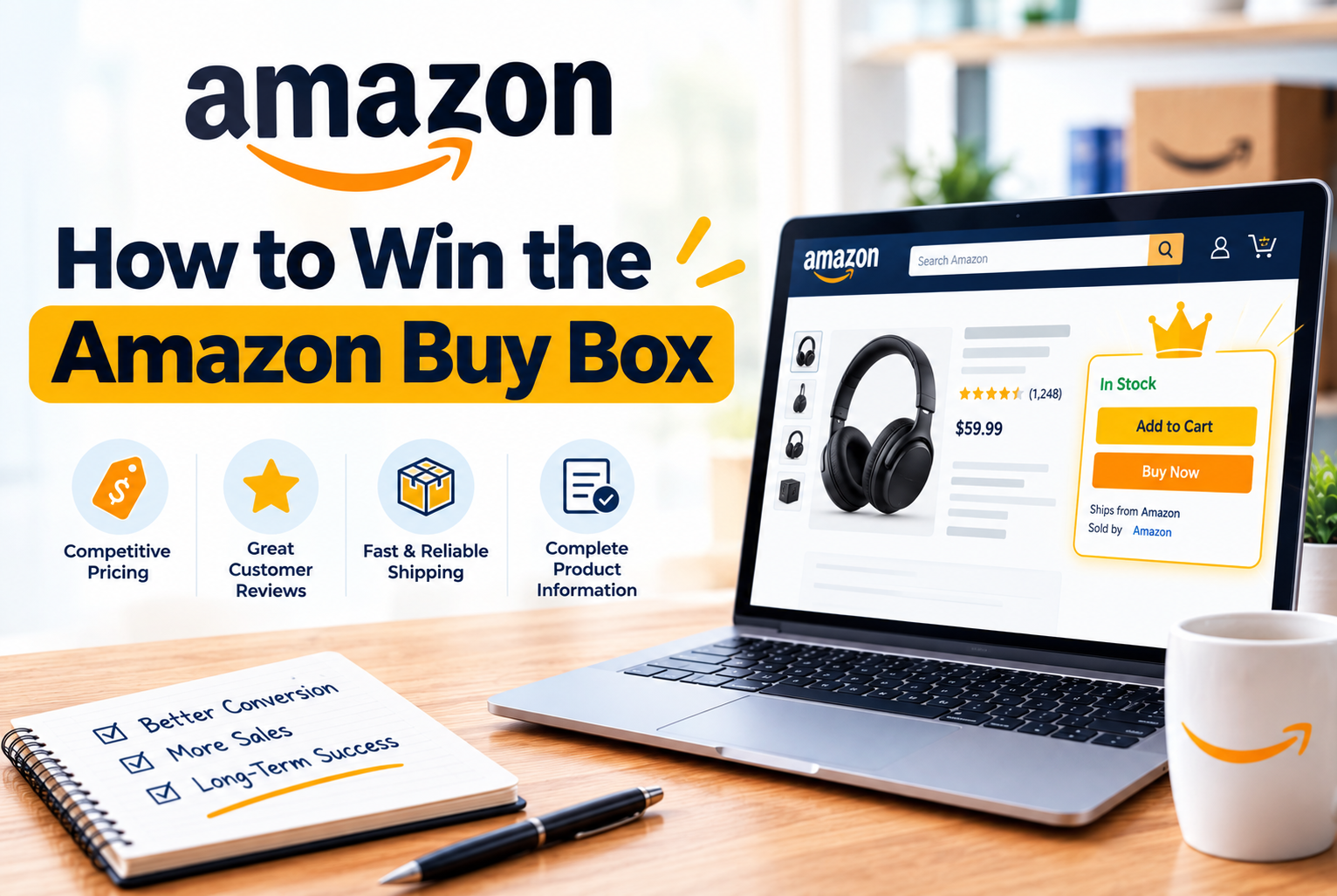
If you are selling on Amazon and not winning the Buy Box on your own listings, you are handing revenue to competitors, sometimes on products you sourced, photographed, and listed yourself. Studies consistently show that 80 to 90% of all Amazon sales go through the Buy Box. The remaining shoppers who click “Other Sellers” to compare options are a small minority, especially on mobile.
This guide covers what the Buy Box algorithm actually evaluates in 2026, what has changed in the last 12 to 18 months, the metrics that matter, and a realistic step-by-step strategy for winning and maintaining Featured Offer share.
Table of Contents
- Buy Box vs Featured Offer: The Terminology
- How to Check Your Eligibility
- The 5 Factors That Determine Who Wins
- What Changed in the Last 12 to 18 Months
- How Long It Takes for New Sellers
- Common Myths
- A Step-by-Step Strategy
Buy Box vs Featured Offer: The Terminology
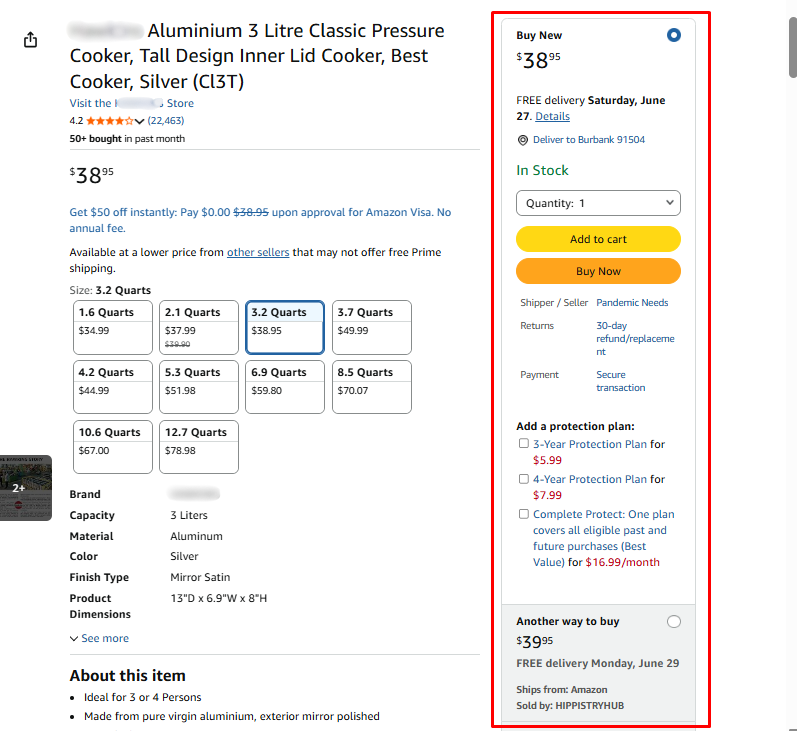
Amazon officially rebranded the Buy Box to “Featured Offer” in its documentation and Seller Central interface. Both terms refer to the same thing: the prominent Add to Cart and Buy Now placement on the right side of every product detail page. You will see both terms used throughout Seller Central, reports, and Amazon’s own help documents. They mean exactly the same thing.
How to Check Your Eligibility
Before you can win the Buy Box, confirm you are eligible. There are two reliable places to check in Seller Central.
Method 1: Manage Inventory
Go to Inventory > Manage Inventory. Look for the “Featured Offer”.
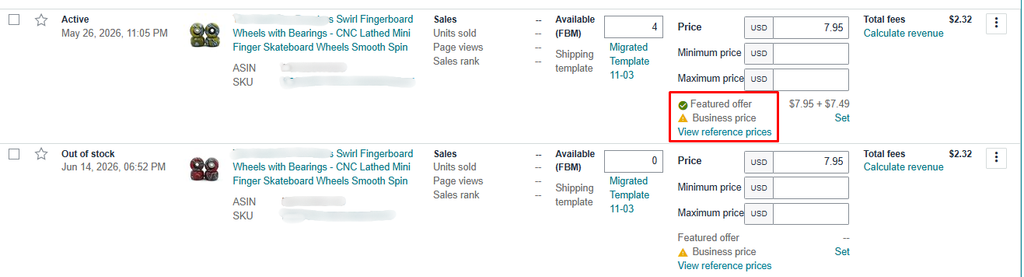
If you do not see it, click the gear icon in the top right of your inventory table and enable it. You will see one of three statuses: Eligible, Not Eligible, or Ineligible. Eligible means you meet the minimum requirements. Not Eligible or Ineligible means there is an account or listing issue preventing you from competing.
Method 2: Account Health Dashboard
Go to Performance > Account Health and check the Product Policy Compliance section for any Featured Offer restrictions or warnings.
| Eligibility means you have cleared the minimum requirements to compete. It does not mean you will win.If you are eligible but not winning, the issue is almost always pricing, metrics, or seller authority relative to your competitors. |
The 5 Factors That Determine Who Wins
1. Total Landed Price
Amazon does not evaluate your product price in isolation. It evaluates your total landed price: product price plus shipping. A seller offering $26.99 with free shipping will beat a seller offering $24.99 with $4.99 shipping because the landed price of $26.99 beats $29.98.
In 2026, the competitive pricing window has tightened significantly. Sellers used to be able to price 8 to 10% above the lowest landed price and still win decent Buy Box rotation. That tolerance is now typically 3 to 5%. If you are more than 5% above the lowest competitive offer, you are likely losing most of your Buy Box share.
- Monitor total landed price weekly, not monthly
- If you charge separate shipping, calculate whether building shipping into a higher product price gives you a better landed price position
- Watch for Amazon’s unfair pricing flags: if your price looks anomalous versus category history, Amazon may suppress the Buy Box entirely even if you are the only seller
2. Fulfillment Method and Delivery Speed
FBA still gives you the clearest path to Buy Box dominance because Amazon trusts its own fulfillment network. But in 2026, the algorithm now weights regional delivery speed more heavily than overall average delivery time. An FBM seller who can reliably deliver next-day to major metros (New York, Los Angeles, Chicago, Dallas) may win Buy Box share in those regions even against FBA competitors, while losing it in regions where their delivery is slower.
- FBA sellers: check your inventory placement. Stock distributed across multiple fulfillment centers outperforms stock staged in a single location.
- FBM sellers: audit your delivery speeds by region. Identify where you can consistently deliver in 1 to 2 days and focus your competitive efforts there.
- Seller Fulfilled Prime (SFP) can compete with FBA if you maintain same-day or next-day handling and premium carrier use across all US addresses.
3. Account Health Metrics
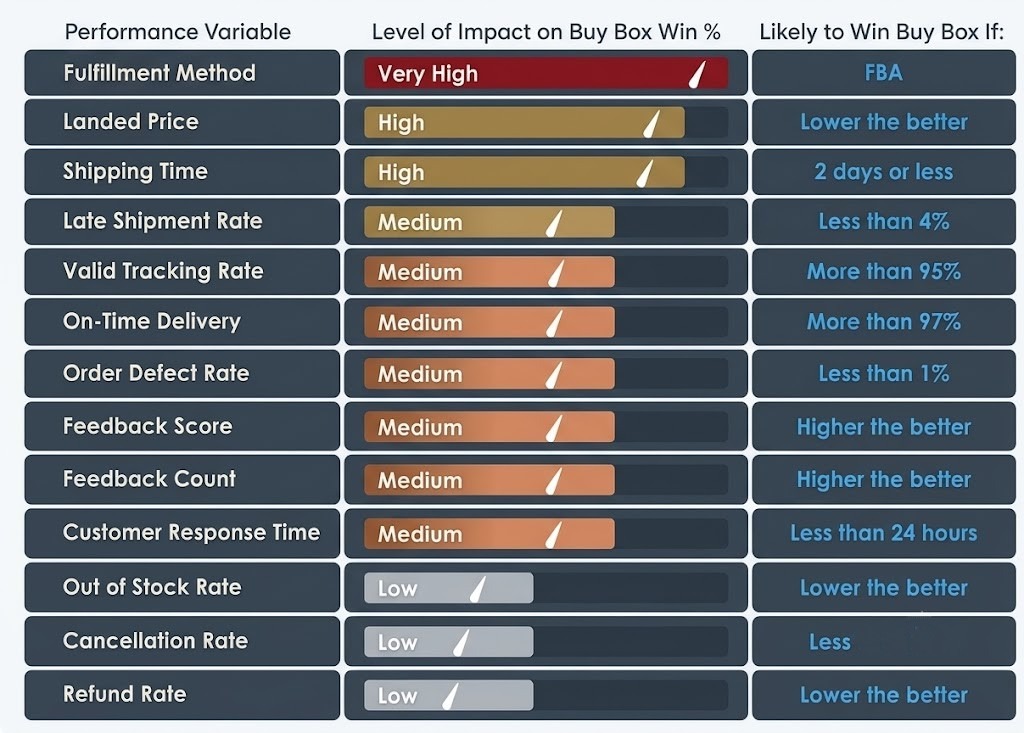
Your metrics function as both gates and ranking signals. Fall below Amazon’s thresholds and you lose eligibility. Hover near the thresholds and you lose Buy Box rotation to sellers with stronger numbers. The real targets are well above Amazon’s stated minimums:
- Order Defect Rate: Below 0.5% (Amazon’s threshold is 1%). ODR above 1% risks account suspension, not just Buy Box loss.
- Late Shipment Rate: Below 2% (threshold is 4%). Sellers consistently under 1% win measurably more Buy Box time.
- Pre-Fulfillment Cancel Rate: Under 1% (threshold is 2.5%).
- Valid Tracking Rate: 98% or higher (threshold is 95%).
- On-Time Delivery Rate: 97% or higher. Amazon introduced OTDR as an explicit metric in 2024 and its Buy Box weighting has increased significantly in 2026.
4. Seller Authority and Trust Signals
This is the factor that frustrates new sellers most and has become more influential in 2026. Amazon’s algorithm weighs account age, total feedback volume, historical return rates, and category experience when distributing Buy Box time among otherwise qualified sellers.
A seller with 5,000 transactions and 500 feedback ratings over two years is a known quantity. A seller with 50 transactions and 10 ratings over two months is a risk. Even with perfect current metrics, the newer seller will win less Buy Box time until they have built a comparable track record.
Amazon is also distributing Buy Box time more evenly among multiple qualified sellers than it used to. A previously dominant seller who held 90% Buy Box share may now see 60 to 70%, not because they have gotten worse, but because Amazon rotates the position among more qualified sellers.
5. Listing Quality and Conversion Rate
Listing content does not directly feed the Buy Box algorithm, but it affects conversion rate, and conversion rate influences how Amazon values your offer over time. Strong listing content produces higher conversion, which signals to Amazon that customers prefer your offer, which improves Buy Box treatment gradually.
- Professional main image with white background, clear at small sizes on mobile
- Complete bullet points answering key customer questions
- A+ Content for Brand Registered sellers
- At least 6 to 7 total images
In 2026, the algorithm appears to weight recent conversion trends more heavily. A listing with improving conversion may get better Buy Box treatment than one with flat or declining conversion, even if both sellers have similar prices and metrics.
What Changed in the Last 12 to 18 Months
- Tighter pricing tolerance: The competitive band around the lowest landed price narrowed from roughly 8 to 10% to 3 to 5%. Price monitoring needs to be weekly now, not monthly.
- More Buy Box rotation: Amazon is distributing Featured Offer time more evenly among qualified sellers. Even strong sellers rarely hold 100% Buy Box share in 2026. This is intentional, not a problem to fix.
- Regional delivery speed weighting: The algorithm now evaluates delivery speed by region, not just overall average. FBM sellers with strong regional delivery can compete where they previously could not.
- Stronger weight on seller authority: The gap between new and established sellers has widened in terms of Buy Box allocation. New sellers need stronger price advantages to offset the authority disadvantage.
- Higher FBM competitiveness: High-performing FBM operations with excellent metrics and 1 to 2 day regional delivery are winning more Buy Box share than they could in 2023 to 2024.
How Long It Takes for New Sellers
There is no fixed timeline because authority builds based on order volume, not calendar time. As a rough guide:
- Weeks 1 to 2: Focus on generating your first sales. You are likely not winning the Buy Box yet.
- Weeks 3 to 6: With strong metrics, you may see occasional Buy Box eligibility.
- Months 2 to 3: Steady sales volume and excellent metrics should produce more regular Buy Box rotation.
- Months 4 to 6: Consistent rotation into the Buy Box alongside established sellers becomes realistic.
| New sellers face a real catch-22: you need sales to build authority, but the Buy Box generates most sales.Break this cycle with competitive pricing early, PPC ads to generate volume without the Buy Box, and choosing less competitive products where you can build transaction history faster. |
Common Myths
- The lowest price always wins. The lowest total landed price gives you an advantage but does not guarantee the Buy Box. A seller priced 2 to 3% higher with better metrics or stronger authority can still win more rotation.
- FBA guarantees the Buy Box. FBA improves your odds significantly but is not automatic. An FBA seller with poor metrics or uncompetitive pricing will lose to better-performing sellers, including FBM sellers in some cases.
- A+ Content directly improves Buy Box eligibility. A+ Content helps conversion rate, which indirectly helps over time. But it cannot fix Buy Box problems caused by pricing or metrics.
- Once you win the Buy Box it is yours. Buy Box placement is dynamic and changes continuously based on pricing, stock, delivery speed, and rotation. Even dominant sellers rarely hold 100% share.
- New sellers cannot win the Buy Box. New sellers can win placement but need stronger fundamentals (better pricing, better metrics) to offset the authority gap. It is harder, not impossible.
A Step-by-Step Strategy
Step 1: Confirm Eligibility
Get your Professional Seller account, choose a fulfillment method, list your products accurately, and generate your first 10 to 20 sales to establish baseline metrics. Without some transaction history, Buy Box eligibility is limited regardless of everything else.
Step 2: Build Your Metrics Well Above Thresholds
Treat Amazon’s stated thresholds as floors, not targets. Ship every order on time, use tracked shipping on every package, keep inventory accurate to avoid cancellations, and respond to customer issues before they escalate. Build systems (checklists, reminders, reorder triggers) rather than relying on habits.
Step 3: Optimize Your Landed Price Position
Check the current lowest total landed price on your listings weekly. Calculate your own total landed price. Stay within 3 to 5% of the most competitive offer. If your costs do not support competitive pricing, you are either in the wrong product or need to reduce your cost structure before competing effectively for the Buy Box.
Step 4: Fix Listing Fundamentals
Professional main image, complete bullet points, accurate title, A+ Content if Brand Registered, and at least six to seven images. Test your listing on a mobile phone. Most Amazon shoppers browse on phones, and a listing that looks poor on a small screen converts poorly regardless of how well it is priced.
Step 5: Build Authority Consistently
Maintain excellent metrics month after month. Gradually increase sales volume. Accumulate positive feedback politely without violating Amazon’s policies. Expand in related categories to build category authority. There is no shortcut to this, and sellers who try to game it through fake reviews or manipulated feedback eventually lose their accounts and everything with them.
Step 6: Monitor Weekly
Check your Buy Box percentage in Business Reports (Detail Page Sales and Traffic) weekly. When Buy Box share drops, check four things in order: pricing competitiveness, metric degradation, stock levels, and new competitors. The answer is almost always in one of those four areas.