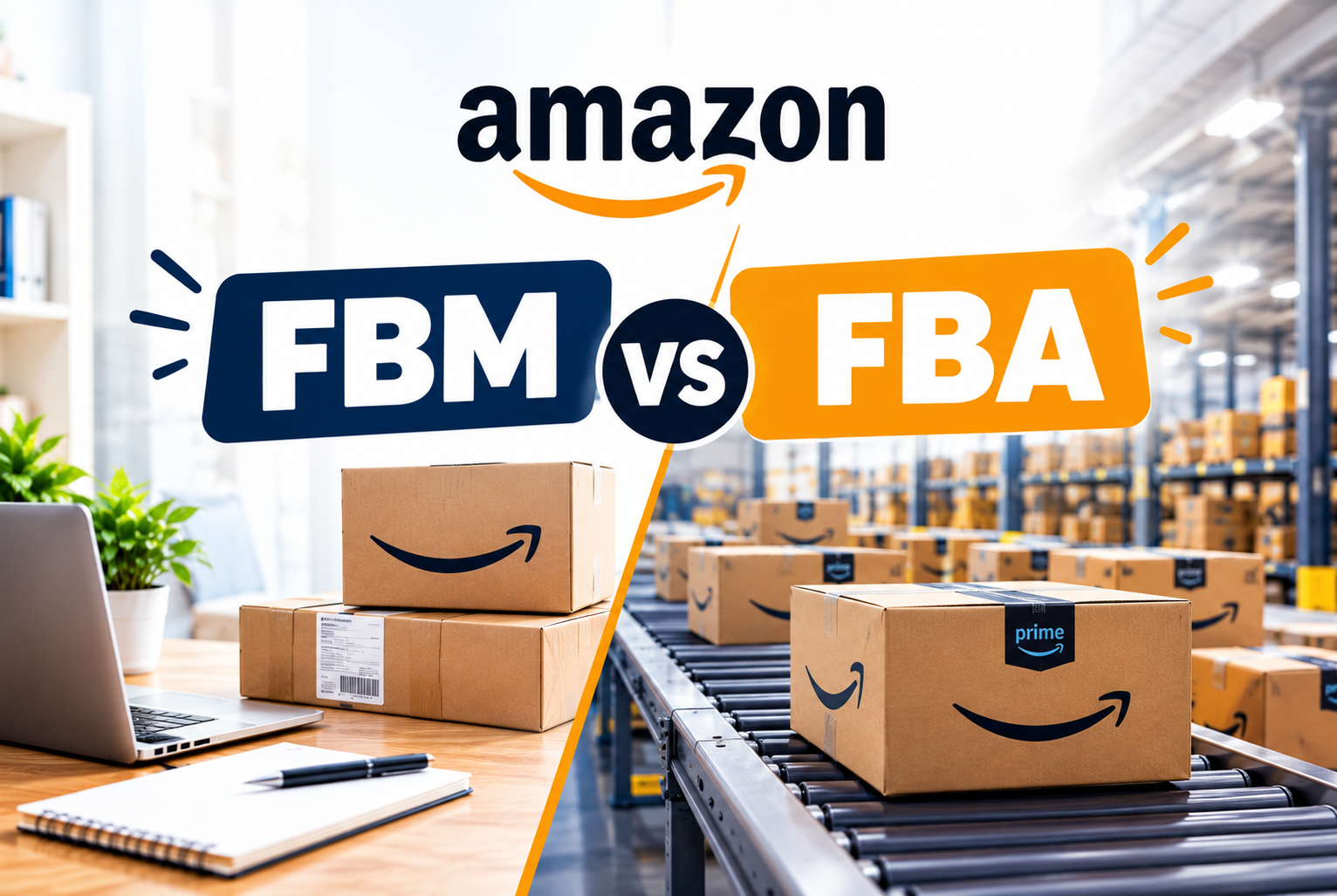
Choosing between Fulfillment by Amazon (FBA) and Fulfillment by Merchant (FBM) is one of the most consequential decisions you make as an Amazon seller. It affects your margins, your operational workload, your conversion rate, and your visibility in search. And in 2026, with Amazon’s fee structure more complex than ever, the math behind this decision matters more than it did even two years ago.
This guide cuts through the noise and covers exactly how each model works, what it actually costs in 2026, where each one wins, and why the smartest sellers are running both rather than choosing one and sticking with it for their entire catalog.
Table of Contents
- How FBA Works
- How FBM Works
- The Real Cost Comparison in 2026
- Where FBA Wins
- Where FBM Wins
- Seller Fulfilled Prime: The Middle Ground
- The Hybrid Strategy: Why Most Serious Sellers Use Both
- How to Decide Per SKU
How FBA Works
With Fulfillment by Amazon, you ship your inventory in bulk to Amazon’s fulfillment centers. From there, Amazon handles everything: storage, picking, packing, shipping to the customer, customer service, and returns. Your products automatically receive the Prime badge and qualify for free two-day and same-day delivery for Prime members.
The tradeoff is cost and control. Amazon charges a referral fee on every sale, plus a per-unit fulfillment fee based on product size and weight, monthly storage fees, and in 2026 several additional fees that did not exist a few years ago. You also give up control over how your product is packaged and shipped, and your inventory is distributed across multiple fulfillment centers, meaning you cannot easily access it for photography, quality checks, or bundling.
How FBM Works
With Fulfillment by Merchant, you store your own inventory and handle packing and shipping yourself, or through a third-party logistics provider (3PL). Amazon still charges the referral fee on every sale, but you avoid FBA’s fulfillment and storage fees entirely. Instead, you carry your own costs for warehouse space, packaging materials, labor, and shipping.
FBM gives you full control over packaging, branding inserts, and the customer experience. It also means you are responsible for handling every customer inquiry, return, and refund independently. Without a Prime badge (unless you qualify for Seller Fulfilled Prime), FBM listings convert at a lower rate than FBA listings in most product categories, all else being equal.
The Real Cost Comparison in 2026
Most sellers make the mistake of comparing only the fulfillment fee versus their self-fulfillment shipping cost. In 2026, the true cost of FBA is significantly broader than that single line item.
The complete FBA cost stack for any unit includes:
- Referral fee (same for FBA and FBM, typically 8% to 15% of sale price)
- FBA fulfillment fee per unit (based on size tier and weight, up on average $0.08 per unit in 2026 vs 2025)
- 3.5% fuel surcharge applied to the fulfillment fee (introduced April 2026)
- Monthly storage fee (standard rates off-peak, approximately 2.5x higher in Q4)
- Inbound placement fee if shipping to a single location rather than splitting shipments ($0.50 to $6.50 per unit depending on product)
- Low-inventory-level fee if stock falls below 35 days of supply for high-velocity SKUs
- Aged inventory surcharge if stock sits past 181 days (threshold dropped from 271 days in 2026)
The complete FBM cost stack includes:
- Referral fee (same as FBA)
- Outbound shipping cost per order
- Packaging materials
- Warehouse or 3PL storage and handling costs
- Labor or 3PL pick-and-pack fees
| Sellers who benchmarked their FBA economics two or three years ago and have not recalculated are likely underestimating what FBA actually costs per unit in 2026.Run the numbers fresh for each SKU, not just for the category as a whole. |
For lightweight, fast-moving products (under 1 lb, selling 100+ units per month), FBA typically wins on total cost once you factor in the Prime conversion lift. For heavy, bulky, or slow-moving products, the FBM cost structure almost always wins when calculated honestly.
Where FBA Wins
FBA is the right choice when the economics and operational trade-offs make sense for that specific product.
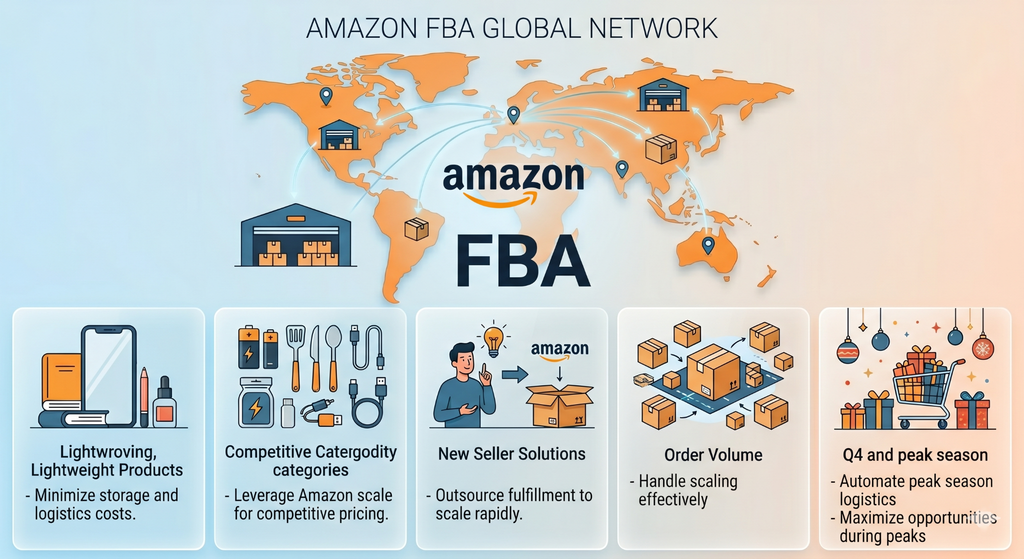
- Fast-moving, lightweight products. Small standard-size items with FBA fulfillment fees in the $2.43 to $4.00 range benefit from the Prime badge without the fee stack becoming prohibitive. Prime listings convert 20 to 30% better than equivalent non-Prime listings in competitive categories.
- Competitive commodity categories. When multiple sellers offer the same or a very similar product, an FBA offer will typically win the Buy Box over an FBM offer priced within 1 to 2% of it. For commodity products, FBA is often not just a convenience but a prerequisite for maintaining visibility.
- New sellers without fulfillment infrastructure. FBA removes the operational complexity of running your own logistics operation, freeing you to focus on product selection, listing optimization, and marketing while you are still figuring out what sells.
- High order volume. At scale (over 1,500 orders per month), managing FBM in-house requires dedicated staff, warehouse systems, and management overhead. FBA absorbs volume increases without additional operational complexity on your end.
- Q4 and peak season. Amazon’s fulfillment network handles shipping volume spikes that would overwhelm most self-fulfillment operations. Having inventory in FBA during Q4 removes the risk of missing cut-off dates or falling behind on shipments during the busiest weeks of the year.
Where FBM Wins
FBM consistently outperforms FBA in specific situations that are more common than many sellers expect.
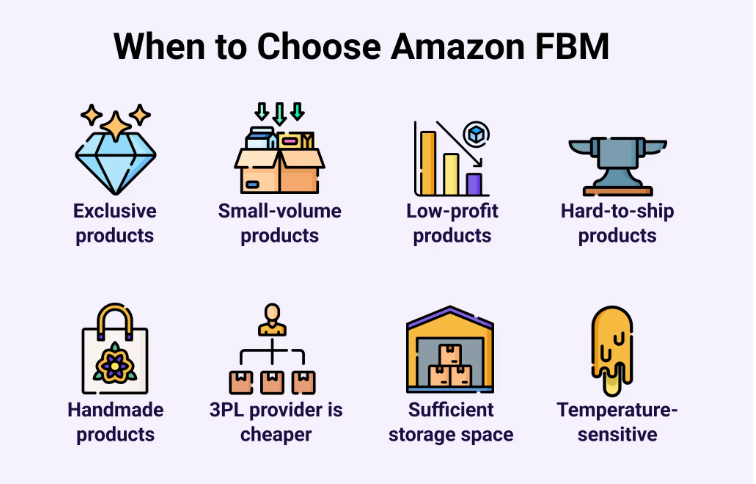
- Heavy or oversized products. Anything over 3 lbs starts accumulating steep FBA surcharges. Large bulky items can face inbound placement fees of $1.30 to $6.50 per unit on every inbound shipment, on top of already elevated fulfillment fees. For a 20-pound item, FBM with negotiated carrier rates is almost always more profitable.
- Slow-moving or seasonal inventory. FBA’s storage fees increase significantly for inventory sitting past 181 days (tightened from 271 days in 2026). If your product sells slowly or has a defined seasonal window, the storage and aging surcharges in FBA can eliminate your margin. FBM lets you hold inventory in your own space without per-cubic-foot charges.
- Products requiring custom packaging or special handling. If your product needs custom packaging to prevent damage, specific assembly, or personalization, FBM is the only option. Amazon’s standardized fulfillment process cannot accommodate products that require anything outside its standard pick-pack-ship workflow.
- Sellers with existing 3PL or warehouse infrastructure. If you already have a fulfillment setup for DTC or wholesale orders, routing Amazon FBM orders through the same operation consolidates your inventory and eliminates the need to maintain a separate FBA inventory pool.
- High-margin products where brand experience matters. FBM allows you to include branded packaging, personalized inserts, and thank-you notes. For brands where the unboxing experience is part of the value proposition, FBM preserves something FBA structurally cannot offer.
Seller Fulfilled Prime: The Middle Ground
Seller Fulfilled Prime (SFP) lets you display the Prime badge on FBM listings while fulfilling orders yourself or through a qualifying 3PL. On paper it combines FBM’s cost structure with FBA’s conversion advantage. In practice, the requirements are demanding enough that most individual sellers cannot meet them without a well-resourced logistics operation.
SFP requires same-day or next-day handling cutoffs, premium carrier use for all shipments, coverage across all US addresses including Alaska, Hawaii, and US territories, and sustained performance metrics including at least 93.5% on-time delivery and 99% valid tracking. Sellers who fail to maintain these standards lose SFP status.
SFP makes the most sense for sellers with products priced above $50 (where the Prime conversion lift justifies the premium carrier costs), an existing multichannel fulfillment setup with tight cutoff discipline, and products where FBA fees would exceed 25% of the sale price. For most small to mid-size sellers, the operational burden outweighs the benefits, and a hybrid FBA-FBM approach is more practical.
The Hybrid Strategy: Why Most Serious Sellers Use Both
The most successful Amazon sellers in 2026 do not pick one model and apply it to their entire catalog. They run both FBA and FBM simultaneously, with each method assigned to the SKUs where its economics make sense.
The most common hybrid patterns:
- FBA for the top 20% of SKUs: bestsellers, competitive commodities, lightweight items where the Prime badge and Buy Box advantage matter most
- FBM for long-tail variants, colors, and sizes that move slowly and would rack up storage and placement fees in FBA without generating enough volume to justify the cost
- FBM as a stockout safety net: keeping an active FBM listing on every FBA product so that if FBA stock runs out or a shipment is delayed, the listing stays live and search ranking is protected
- FBM for oversized or heavy items where FBA fees eat into margin regardless of sales velocity
| Roughly 40% of six-figure Amazon sellers use a hybrid fulfillment approach.The goal is not to simplify your operations into one model. It is to optimize margin and visibility per SKU. |
How to Decide Per SKU
Before assigning a fulfillment method to any product, calculate the true landed margin under each model using current 2026 fee rates, not last year’s numbers.
- Use Amazon’s Revenue Calculator in Seller Central to get current FBA fee estimates for your specific ASIN, including size tier classification, weight, and any applicable surcharges.
- Calculate your FBM total cost: outbound shipping at your carrier rate, packaging materials, pick-and-pack labor or 3PL handling fee, and storage cost per unit per month.
- Compare the two total cost figures, then apply the Prime conversion lift (typically 20 to 30% higher conversion) to the FBA option to account for the revenue difference, not just the cost difference.
- If FBA still wins on margin after accounting for the fee stack, assign that SKU to FBA. If FBM wins, assign it to FBM and set up the listing accordingly.
- Recalculate at least once per year, or whenever Amazon updates its fee schedule, since the math shifts as your product mix, volume, and storage patterns change.
FBA versus FBM is not a one-time decision you make when you launch. It is an ongoing, per-SKU optimization that changes as your catalog grows, your volume increases, and Amazon’s fee structure evolves. The sellers who get this right are the ones who run the numbers honestly for each product rather than defaulting to one model for convenience and never revisiting it.